


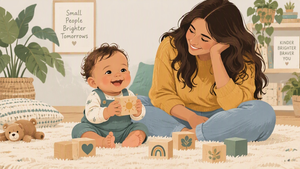
Your baby is 10 months old and not crawling yet. You may be seeing other babies moving in different ways and wondering: Should I be worried? The short answer is: not necessarily.
In this article, we look at what matters more than crawling itself, when to seek advice, and simple play ideas that can encourage movement at home.
Babies learn to move in different ways and at different times. Some crawl on their hands and knees, while others commando crawl, roll or shuffle on their bottom. A few skip crawling altogether and move on to pulling up, cruising and walking.
Rather than focusing on crawling alone, it is more helpful to look at your baby’s overall movement, curiosity and progress over time.
Look at the whole movement picture
At around 10 months, many babies are becoming increasingly active on the floor. They may sit and reach for toys, roll, pivot on their tummy or begin moving between positions.
Consider whether your baby:
- Is gradually developing new movement skills
- Sits independently and reaches for toys
- Rolls or turns to explore their surroundings
- Uses both sides of their body during play
- Attempts to move towards people or interesting objects
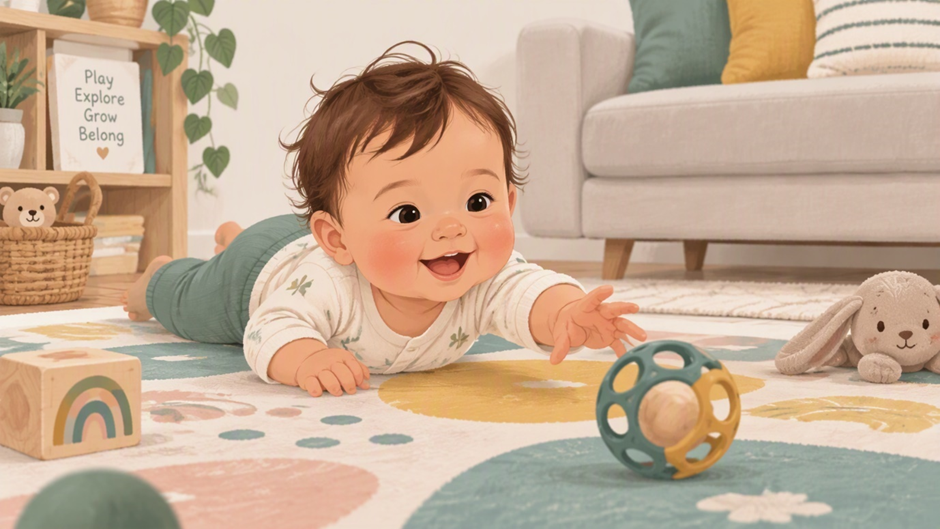
Your baby does not need to demonstrate every skill on this list. Development is not a checklist, and children do Your baby does not need to demonstrate every skill on this list. Development is not a checklist, and children do not always learn skills in the same order.
What matters is whether your baby is making progress and finding ways to interact with the people, toys and spaces around them.
For more information about how babies learn and develop, visit the Raising Children Network’s baby development resources. Baby development and developmental milestones | Raising Children Network
When should I seek advice?
Not crawling at 10 months is not usually a concern by itself. However, it is worth seeking professional advice if your baby:
- Is not yet sitting independently
- Remains mostly in one position and does not attempt to roll, reach, pivot or move
- Consistently uses one side of their body more than the other
- Drags one arm or leg when moving
- Feels consistently much stiffer or floppier than expected
- Does not take weight through their legs when supported
- Has difficulty controlling their head
- Loses a movement or interaction skill they previously used
Seek prompt medical advice if your baby suddenly loses previously acquired skills, has a significant change in movement, alertness or general health, or if you are worried that something has changed quickly.
You know your baby best. If something does not feel right, it is reasonable to speak with your GP, child and family health nurse, paediatrician or paediatric physiotherapist. An assessment may provide reassurance, practical ideas or additional support.
Helping your baby move through play
You do not need specialised equipment or expensive developmental toys. Babies learn through everyday play and repeated opportunities to move.
1. Make more opportunities for floor play
Bouncers, swings, highchairs and supportive seats can be helpful at different times of the day. However, babies also need regular opportunities to move freely and practise changing position.
Place your baby on a safe, firm surface where they can roll, reach and experiment with movement. Stay nearby and join their play by talking, copying their sounds or positioning yourself where they can see you.
Several short periods of enjoyable floor play throughout the day may be more manageable than one long session, particularly if your baby is not accustomed to playing on the floor.
2. Adapt tummy play
If your baby does not enjoy lying on their tummy, try adapting the position rather than forcing them to remain there. You could:
- Lie back and place your baby on your chest
- Position them across your lap
- Place a small rolled towel under their upper chest while supervising closely
- Lie face-to-face with them on the floor
- Use a mirror, favourite toy, song or family member to encourage them to look up and reach
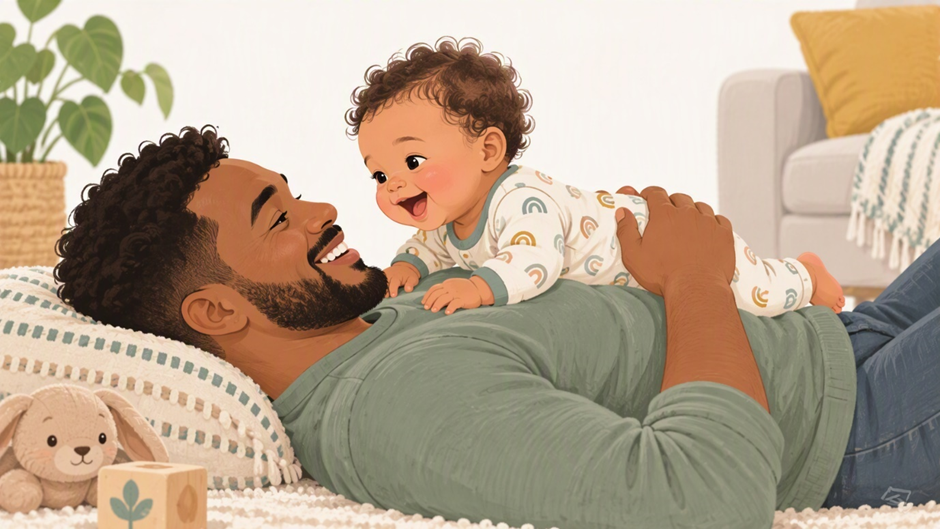
The aim is to help your baby feel safe and interested while practising pushing through their arms, lifting their head and shifting their weight. For more ideas, read Making tummy time a happy time: A guide for parents.
3. Encourage reaching and changing position
Place an interesting toy slightly to the side rather than directly in front of your baby.
When sitting, reaching sideways can encourage turning, weight shifting and placing a hand on the floor. During tummy play, positioning toys in different directions can encourage reaching and pivoting.
Keep the activity playful and achievable. The aim is to invite movement, not to frustrate or pressure your baby.
How a physiotherapist can help?
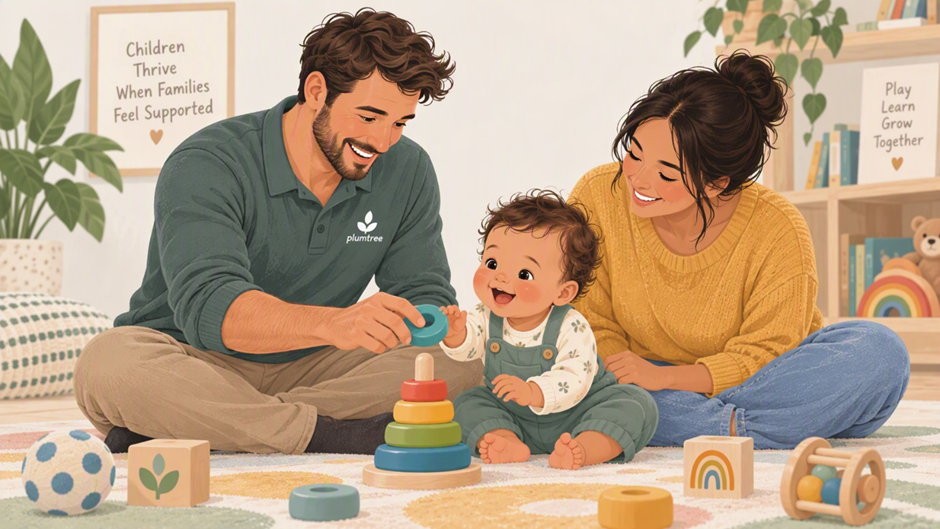
A paediatric physiotherapist – a health professional who helps children move and play – can conduct an assessment, it is usually play-based and adapted to your baby’s interests, comfort and current movement skills.
The physiotherapist will listen to your concerns and observe how your baby sits, rolls, reaches, changes position and uses both sides of their body. They will also consider your baby’s strengths, daily routines and the activities you would like them to participate in.
If support is recommended, the physiotherapist can suggest practical strategies that fit naturally into play, dressing, carrying, floor time and other family routines.
The goal is not simply to teach your baby to crawl. It is to help them develop the movement skills and confidence they need to explore, play and participate in everyday life.
You do not need to wait and worry
Not crawling at 10 months does not automatically mean that your baby has a developmental delay. There is a broad range of movement development, and some babies find their own way of getting around.
However, you do not need to manage ongoing concerns alone. Seeking advice early can provide reassurance and help you understand how best to support your baby.
If you are unsure whether your baby’s movement is within the broad range of typical development, a conversation with a qualified health professional can help you decide whether monitoring, play-based strategies or a formal assessment is the right next step.
Concerned about your baby’s movement?
Plumtree’s paediatric physiotherapists use a strengths-based, play-based and family-centred approach. We work with families to develop practical strategies that support children’s movement and participation in everyday routines.
Learn more about Plumtree’s paediatric physiotherapy services, or contact our team to discuss whether an assessment may be helpful for your child.
This article provides general information and is not a substitute for individual medical, developmental or physiotherapy advice.
Explore more support for you and your child
If you’re looking for gentle, practical information or ways to connect with other families, these resources can help you think about what might support your child and family right now.

